For three weeks every March, the gap in Daylight Savings Time (l'heure d'été) between the U.S. and France puts Lyon just six hours ahead of Chicago, instead of the usual seven. Maybe it is an exaggeration, but the extra hour helped us overcome our jet-lag, and after just two nights sleeping under a warm hospitable French roof, we were feeling great. We were up and about by 9:00, and we joined
our host family around the table for a breakfast of praline escargots (buns) and croissants, with coffee and juice. We learned that morning of the very popular Nespresso brand of coffee maker. These are single-serving espresso makers, with a size selection of small, and very small. Of course, espresso contains about 6 times more caffeine per ounce than American coffee, so we were not lacking in pep, vim, and vigor after just one small cup of Nespresso. Offer us a second cup, and we are ready to go for the whole day!! Interestingly, the spokesman for Nespresso in France is American actor George Clooney, and the commercials are in English with subtitles in French. We watched several of the commercials on YouTube, and they are very entertaining, with Clooney employing his humorous, self-deprecating style. "What else?"


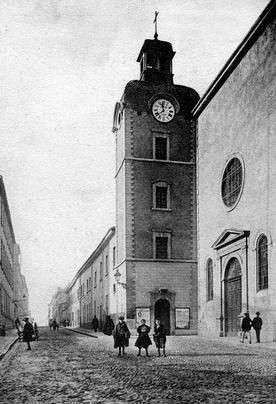
Our third day in France was Palm Sunday, so we bundled up after breakfast and walked the quarter mile to the local parish, Eglise St Denis, on Rue Henon. I later discovered that construction on the church began in 1830, the year of another revolution and the overthrow of Charles X. By 1840, work on the church was finished, and in 1986 it was officially given protected status on the list of historical monuments in Lyon. As we arrived, we purchased palm branches from school children out front, and then entered the church and tried to find seats together for seven people. It was quite crowded, being a holy day, but there was no need to worry about seats.


The priest, M. l'abbé Jérôme Billioud, asked the congregation to exit the church and assemble at the entryway for a special prayer before beginning mass. As I was one of the last people to leave the church, I found myself at the entrance, just in front of the priest. I watched him struggle for the attention of his distracted flock, now standing on the sidewalk, as he began the prayer. And I could also see him handle with aplomb the technical difficulties he was having with his wireless microphone. The amplification of his prayer would cut in and out for those brief minutes, but as I was standing just next to him, and as I understood only about one third of his words, my enjoyment of the opening prayer was not disturbed by the sound system. He sprinkled the assembly with holy water, and we filed back into the church. We had no trouble finding seats together on our return inside. Catholic masses are virtually the same everywhere, so we followed along with the Palm Sunday passion reading despite not speaking the language. The mass was longer than usual, and we were told the priest was known for lengthy sermons even on an ordinary Sunday, but we enjoyed the experience. After mass, as we were leaving, we met some friends of our host family, and had an opportunity to say hello to our architect friend from the soirée the night before.


Mass ended at 11:30, so we took the opportunity to see more of the Croix-Rousse area. It's a wonderfully charming area, and we stopped to see the best cheese shops, chocolatiers, and butchers. We came upon
Le Gros Caillou, which is symbolic of the Croix-Rousse area. It is a huge light-colored rock, which is now the centerpiece of a small plaza which shares its name. The rock is presumed to have come down with the glaciers from the Alps in the distant past. More recently, it was moved about 100 feet to its current location during construction in 2008. "Gros Caillou" is French for large pebble.


This plaza marks the eastern most end of the Boulevard de la Croix-Rousse, so we started a westward walk down the boulevard and through the famous outdoor market, which stretches for several blocks. We strolled this market the day before, but it was closing for the day, so it wasn't a true experience. On Palm Sunday, we had a more typical experience, as the after-church crowd was out and preparing for their evening meals.

We continued strolling the market before returning home for lunch. It was our second day in Lyon, and we were already about to experience the second outstanding local Lyon specialty. It is called quenelle, and it is a poached oval dumpling, made with a variety of ingredients (meat, fish or chicken, or sometimes vegetarian). It can be served in a cream sauce, or as with our lunch on Palm Sunday, in a tomato sauce. Quenelle is a truly flexible dish, and it was delicious. Our hosts served the quenelle with rice and a bottle of white wine. We took this opportunity to recharge our batteries and prepare the the afternoon adventure, which would be to go to the historic "Vieux Lyon".


After lunch, we left our home base of the Croix-Rousse and hopped aboard the metro system. It was a bit of a challenge since metro tickets are fully automated in most places and can only be purchased from a kiosk with a European style "Chip-and-PIN" credit card or with coins (which are not dispensed from the bank machines). But, once aboard, we found the metro clean, safe and easy. With seven of us in tow, we rode the train south to the Bellecour stop, and switched lines west to the Vieux Lyon stop. From there, we boarded the funicular to make the ascent to St. Just, a station up the Fourvière hill and just a short walk to our destination.


By coming up the Fourvière hill, we were digging deep into history. The city of Lyon was known as Lugdunum in Roman days, and it was far more important than is widely known today. The Roman city was founded in 43 BC, and was the birthplace of two Roman emperors. It was originally founded up on this hill, before the population started to migrate down to the riverside in the waning years of the Roman Empire, in the area we now know as Vieux Lyon ("Old Lyon"). We left the funicular station and began a winding path toward our destination. As we walked, I realized that the brown stone structure we were passing was more than just a centuries old ramshackle hut, but instead it was remnants of a centuries old aqueduct. Lugdunum had four acqueducts to supply it with water, and the structures we were passing represented some of the largest hydraulic relic of the Roman world after Rome itself. The relic we were passing was originally one of the longest aqueducts, spanning almost 50 miles.


As we continued down the road past the aqueducts, we came upon what would have been a highlight of Lugdunum in the days of Christ. The Ancient Theater of Lyon was discovered under an orchard in the first half of the 20th century during an extensive, 46-year archaeological project.


Emperor Augustus constructed the theatre around the year 15 BC. Archaeologists estimate that at its peak, the two tiers and upper covered walkway could seat almost 11,000 spectators. The theater is the largest theater found anywhere in Gaul.


We strolled the upper section, which includes the remains of various rooms, underground passages, drainage ditches, and bars/restaurants. Then, we explored the theater itself. Since it is built into the side of the hill, we entered from the top and walked down the steep steps to the stage.


Originally the view behind the stage would have been blocked by a wall, 90 feet tall. Today, the wall is gone, and the view is of the Saône River with the Presqu'île behind it. After exploring the Roman rooms and paths above the theater, and climbing down and up the steep theater steps, we began the short walk down the road from the Roman theater to find the Basilica of Notre-Dame de Fourvière.


The Basilica is just a quarter mile down the road from the Roman ruins. The basilica and the hill on which it sits take their names from the Roman Forum that was once sitting in that location. The name Fourvière is based on the old French "Forum Vieux". We passed the rectory on the left side of the road as we approached the church on the right. The church is big and beautiful with a large gilded statue of Mary on a tower flanking the church.


It was clear from the photographers and crowd of people inside that this is one of the top tourist sites in Lyon. It receives 1.5 million visitors per year. We attempted to enter the church, and got as far as the entry foyer, but there was a mass being celebrated and we did not wish to disturb. We left the church and circled around the side, when we found the stairs to the lower level. In the basement of the church was another full-size church. This one was empty and quiet, so we had a chance to explore and reflect. The lower level church had a global theme, and there were small shrines to the members of the faith from many different cultures.
As we prepared to leave the church, I was surprised but happy to find a machine that will convert paper Euros to coins. I don't normally get excited about this type of thing, but the metro system does not accept paper, and the bank machines do not distribute coins. It had become a problem, but now I had a pocket full of change and was ready for our next stop on our tour of old Lyon.

 We had just spent the afternoon exploring the hillside of the Fourvière (old forum), walking through the ancient Roman theater, and then lighting candles in the basilica dedicated to Mary in the 19th century. Before we started our descent from the hill to the Renaissance neighborhood called "Vieux Lyon", we stopped to look at the Tour Métallique. This is a radio tower just next to the basilica. It is designed to look like the top third of the Eiffel Tower. The tower opened in 1894 at the Universal Exhibition in Lyon. Our hosts told us that the tower was a republican monument forced upon the city by secularists opposed to the large iconic Basilica of Notre-Dame de Fourvière. It's difficult to know if this is true, but there's no doubt that one cannot see one structure without the other. The tower certainly competes for the eye with the basilica.
 We walked as a group down the steep slopes and stairways from the Fourvière hill to the riverside neighborhood called Vieux Lyon. We had taken a funicular to the top of the hill, so it was surprising how steep the walk was downhill. But that didn't stop some intrepid souls from walking, and even jogging, uphill. We passed them on our way down.

 Vieux Lyon is largest Renaissance district in Lyon, and sits beside the Saône River. The center of this neighborhood is the Place St-Jean, and from the plaza there is a fantastic view of the Fourvière Basilica and the Metallic Tower. Cathédrale Saint Jean-Baptiste is a large church anchoring the plaza. The facade is white, with large red doors, giving it an unusual appearance for a Catholic church. And as we got closer, we saw something else interesting about the facade. There were numerous spots for carvings of saints, as is typical for churches from this era, but the statues were either gone or damaged. The reason is that during the revolution, the saints were interpreted as royalty and the statues were either beheaded or destroyed.
  We walked inside the church, which is a good example of Gothic architecture. It was was very large, but had a warmth to it in spite of the size. And in the back left corner of the church there is a beautiful astronomical clock from the 14th century. It uses mechanical figures to depict scenes from the Annunciation every hour. Unfortunately we had missed the animated display, but it is a big draw for sight-seers at this church.
 In the Middle Ages, this area of the city was the focus of political and religious power. There is a small museum adjoining the cathedral, and it was originally a choir school. It is one of Lyon's few Romanesque buildings.


 We walked through the indoor corridors between houses (called traboules) that kept the silk workers dry hundreds of years ago, and more recently were used to hide members of the French resistance during Nazi occupation in World War II. Lyon was a hub for occupying German forces, and also a stronghold of resistance. The secret passages enabled the local people to escape Gestapo raids. We were also intrigued by the renaissance version of the garage, which are the personal horse stables we found in these hidden corridors. These hallways are private property, but the government of Lyon arranged for some of the remaining ones to be available to curious tourists, who are expected to respect the privacy of the owners.

 We finally returned to home base in the Croix-Rousse via metro, and prepared for the evening meal. We fancied "corn on the cob" to be an American tradition, and it certainly is a staple of late summer barbecue parties. Although we didn't have corn available at that time of year, we prepared cornbread muffins in cast iron corn-shaped muffin tins. It was our humble contribution to a delicious meal that also included fresh pumpkin soup, bread and cheese, fresh fruit for dessert, as well as beer and wine to drink. Another very full day in Lyon!