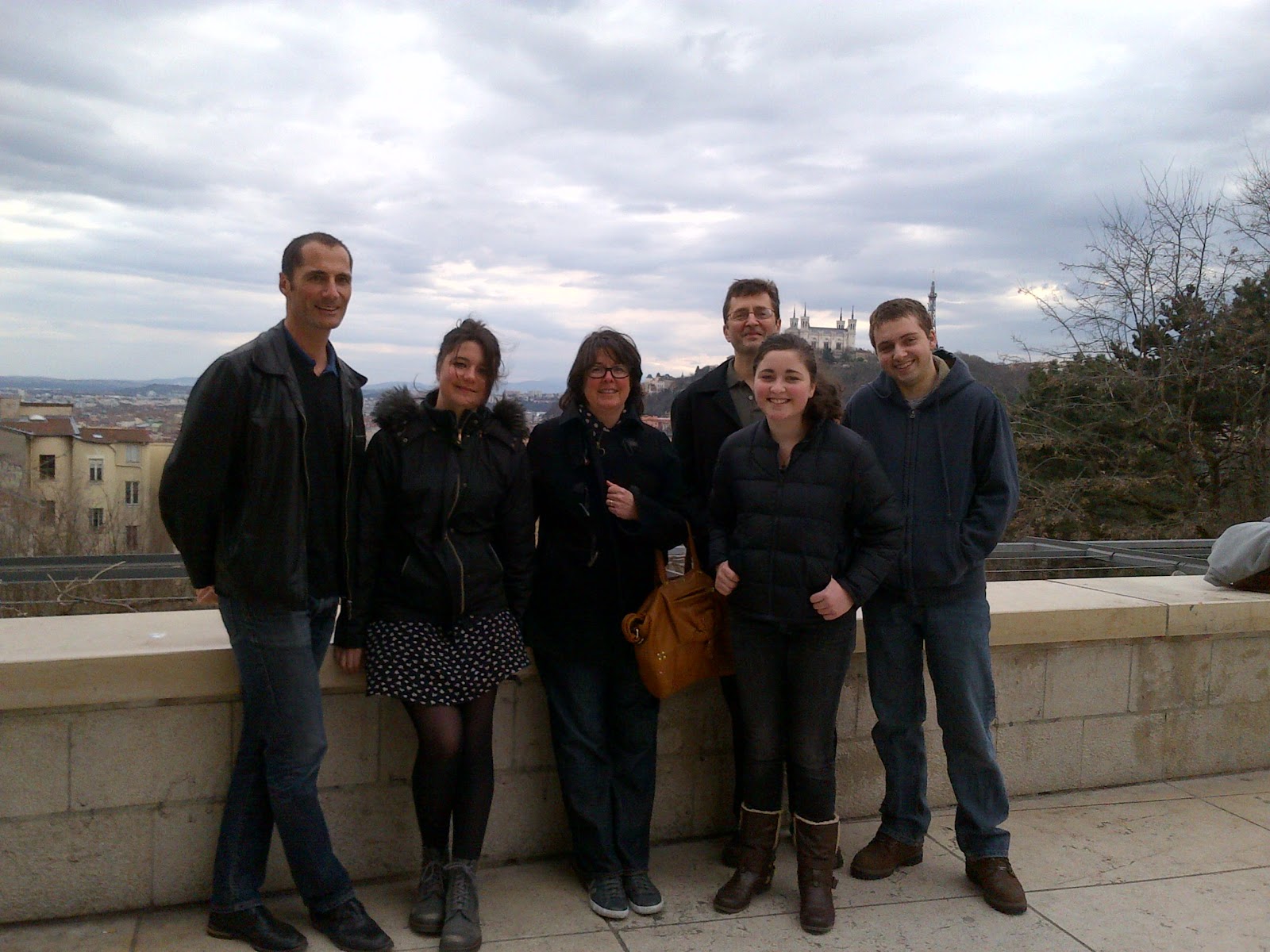
The benefits of staying with a host family while traveling abroad cannot be overstated -- and they are obvious. Hotels are perhaps the biggest obstacle between a traveler and the region in which they are traveling. Hotels attempt to be the great equalizer -- a boundary between where you came from and where you actually are. They attempt to make one feel "at home". But, being at home is not why we travel, is it? So when one has the opportunity to stay with a local family, and to experience the culture first-hand, and to befriend them, and to learn about their struggles and their joys, the choice again is obvious. But, this arrangement, when possible (and let's face it, this is a rare privilege indeed), comes with a challenge that does not burden those in hotels. How to properly express appreciation to the host family?
The first thing to admit is you can't. It may be stressful, but the sooner you realize it the sooner you can get back to enjoying the experience, which is what the host family wants for you anyway. It is a priceless gift to experience travel in this way, so instead, when faced with this dilemma, I decided to share the modest gift of music. Almost everyone loves music from an aesthetic perspective, and even those who don't can appreciate music from a cultural and historical perspective.  So, for that reason, I decided to prepare a collection of music from Chicago. Chicago makes this an easy task, and I decided on a split between Jazz, Blues, Soul/Gospel, and Rock. I tried to include broad chronological diversity -- from Bix Beiderbecke in the 20's to Kurt Elling from today; from Muddy Waters in the 50's to Buddy Guy from today; from Etta James in the 60's to the Chicago Mass Choir of today; from the Buckinghams of the 60's to Lupe Fiasco of today. And I included more in between -- Benny Goodman and Quincy Jones, Howlin' Wolf and Koko Taylor, Lou Rawls and The Staple Singers, Cheap Trick and Smashing Pumpkins. Chicago is blessed to have been home to so many great musicians.
 So, for that reason, I decided to prepare a collection of music from Chicago. Chicago makes this an easy task, and I decided on a split between Jazz, Blues, Soul/Gospel, and Rock. I tried to include broad chronological diversity -- from Bix Beiderbecke in the 20's to Kurt Elling from today; from Muddy Waters in the 50's to Buddy Guy from today; from Etta James in the 60's to the Chicago Mass Choir of today; from the Buckinghams of the 60's to Lupe Fiasco of today. And I included more in between -- Benny Goodman and Quincy Jones, Howlin' Wolf and Koko Taylor, Lou Rawls and The Staple Singers, Cheap Trick and Smashing Pumpkins. Chicago is blessed to have been home to so many great musicians.
 After lunch and the gift exchange on Saturday, we went to explore more of Lyon. Earlier in the day we explored the views over Lyon from the Croix-Rousse, so now we were to descend the hill to see the Presqu'île up close. It was about 4:00PM when we left the pétanque players in the park and started making our way down through the streets of Lyon. The altitude seemed to drop a couple hundred feet as we walked, but it was all downhill -- no problem! Along the way we passed through a section of the historic silk weavers' district, where they would made silk and process it into beautiful fabric, drapery, and wall hangings. The silk industry was established in Lyon in the 15th century, and by the 16th century Lyon held a royal monopoly on silk in France. We had a chance to peek in on an enterprising young couple hard at work rehabbing the ground floor apartment of a former silk workers' loft. As we continued through the side streets and alleys toward the City Hall at the bottom of the hill, we stumbled onto a classic example of a high rise dedicated to the silk workers. The staircase was outdoors to allow for ventilation, but it was covered at the top to ensure the silk and materials stayed dry.
 We continued on, and reached the base of the Croix-Rousse and meandered further into the city when we suddenly came upon a large public square, called the Place des Terreaux. We made our way to the middle of the square, past other tourists snapping photos, and took a good look around. We were standing before the city hall of Lyon. It is called the Hôtel de Ville in French, which was no small source of confusion as some of our party looked around for the city hall wondering why everyone else was looking at the hotel. The city hall was grand and impressive, gilded, and flying the flag of Lyon. The facade, including a relief of Louis XIV, was designed in 1674, and except for a brief period between the revolution and the (temporary) restoration of the Bourbon monarchy, the relief of Louis XIV on horseback has been up there ever since.
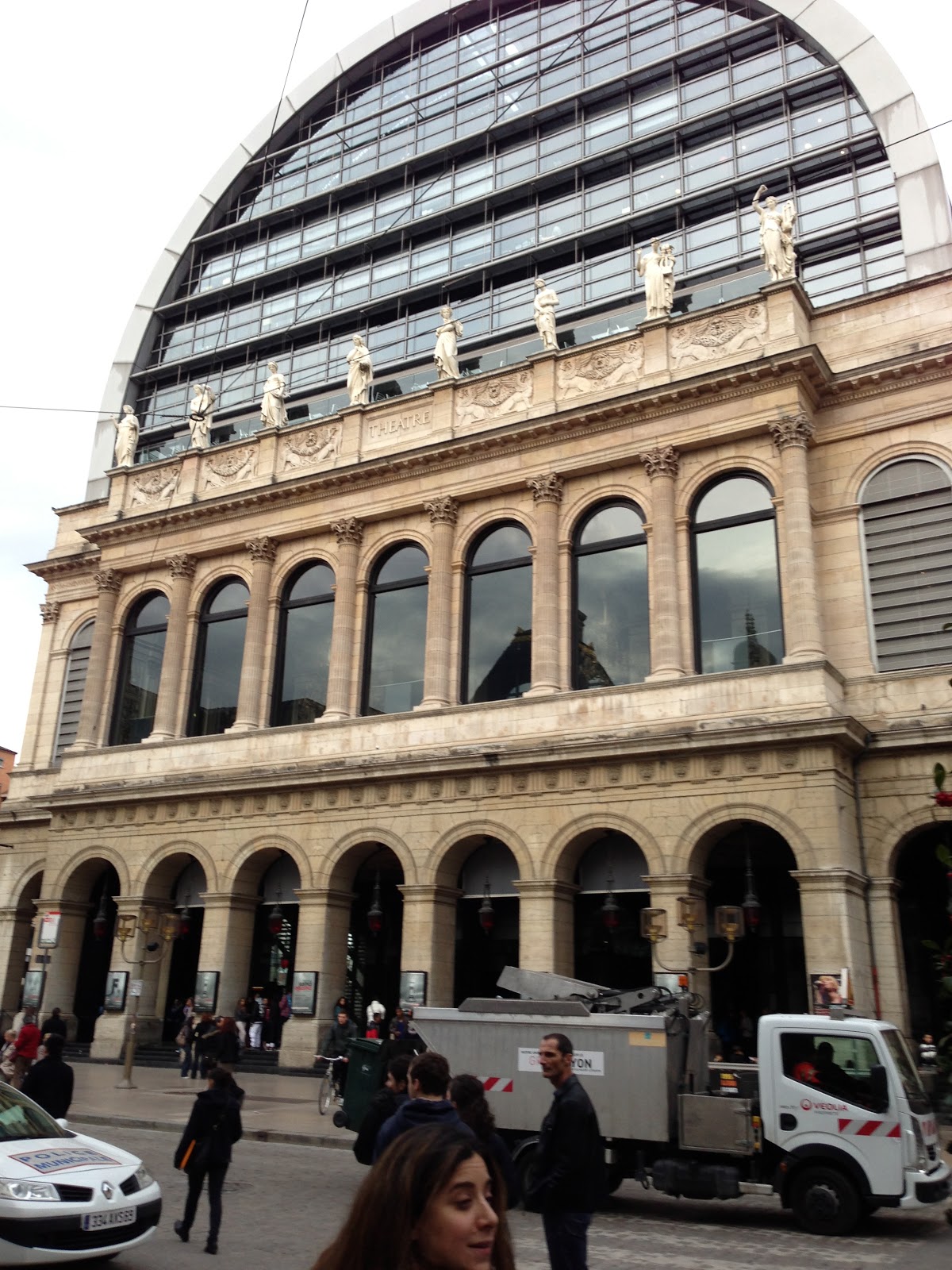 Around the back side of the city hall, opposite the Place des Terreaux, we found Lyon's opera house, called the Opéra Nouvel. It is stunning due to its blend of old and new. The previous opera house was built in 1831, and by the 1980's it was decided that they would re-build. The original facade and foyer was retained, while the rest of the building was gutted to build a theater with triple the capacity of the original. Atop the old facade, the building has a semi-circle cylindrical dome. And although we were unable to see it for ourselves, our hosts assured us the ceiling is amazing. We made a mental note to attend the opera on our next visit to Lyon.
  As we started to make our way further south in the Presqu'île section of the city, we were suddenly distracted by a commotion from across the street. Being in the heart of France, we were surprised to see a store called "Games Workshop", and even more surprised by the growing crowd outside its doors. I'm not a particularly avid "gamer", but since my son is interested, I was curious to know what was going on. Had they released a major new title today? The mystery was solved when we discovered that the crowd had gathered for a big birthday party.
 We continued our walking tour of Lyon, heading south toward our final stop for the day. We arrived in the center of the Presqu'île, to a huge expansive space between the dense buildings. This is the Place Bellecour, the largest clear square in all of Europe. Seriously, you can see this pink stone plaza from satellite photos. There has been a plaza at this space for 400 years. At one point, in 1792, a guillotine was installed here, though I saw no signs of the guillotine today.
  Instead, I saw a statue of Louis XIV on horseback. Louis XIV is known as the Sun King, and is the same king we saw in relief on the facade of city hall. Louis XIV visited Lyon only once, in 1658, which was also the last visit of any French monarch to Lyon. Perhaps this was the reason for the very public homages to the king. This statue was first built in 1713, but was used to make cannons during the revolution, and then replaced in 1825 during the Bourbon restoration. We discovered from our hosts that the statue plays a very practical role as well... it makes for a great meeting place when getting together with friends!
 After this long healthy walk, we took the metro to go up the Croix-Rousse hill and back to the neighborhood where we were staying. We arrived around 7PM, only minutes before friends and neighbors arrived. They were coming for les apéros; a cocktail party with delicious appetizers. When the first guests arrived, I nearly panicked. I had spent seven months trying to learn the French language, but over the past 22 hours since we had arrived, I had very little need to put it to the test. Now, with friends and neighbors arriving, would I be able to communicate with anyone? I was quickly put at ease, though, as the first couple to arrive were fluent in English and did not even attempt to speak French with me. I tried to make an effort to use the French I had worked so hard to learn, but I realized that an interesting conversation requires a nuanced and deep vocabulary -- more than just a few memorized phrases about the weather. Instead, we used English to discuss our travels, their travels, and our common interest in running. We also met the neighbors, who were really quite funny, but I could only appreciate the humor by observing the reactions of the others at the party. I then had an opportunity to speak with a good friend of our hosts, and found he is an architect and has done much traveling in his line of work. I really enjoyed these conversations, and in fact, I found all of our hosts' friends and neighbors to be wonderfully kind and truly interesting people.
 We ate pâté de foie gras with fresh bread, sausage, salmon sashimi, artichokes, and fava beans. We drank white wine, red wine, limoncello, and manzana (apple liqueur). We enjoyed a variety of French cheeses, a praline tart and apple crumble.
 |
| Photo: ©The French Wench 2012 |